
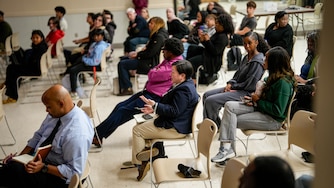
At a town hall hosted by students at the University of Maryland, College Park, on Thursday evening, the school’s interim vice president for belonging told the crowd she personally condemned white supremacy.
But, Stephanie Chang said, she couldn’t speak for the university’s administration.
Chang, who has served in her role for four months, was called to speak by Mohammed Salih, a student organizer who said he was disappointed that the university wasn’t doing more to dispel racism on campus.
“It’s embarrassing to me as an alum, as an administrator, as a person with an opinion about the situation,” Chang told the crowd of about 50 students, faculty and staff about the racist graphic. But, she said, “I cannot speak for the entire administration. I cannot.”
In a statement to The Banner on Monday morning, Katie Lawson, the university’s chief communications officer, said the University of Maryland “denounces white supremacy, as we reject hate in all forms.”
The students gathered on Thursday at the Nyumburu Cultural Center to discuss next steps in their campaign for accountability over a racist illustration shared by members of the club tennis team.
Read More
The image, featuring a depiction of the Maryland state flag with Ku Klux Klan masks, was sent nearly two weeks ago in a packet to other club tennis teams in the region, setting off a firestorm on campus and beyond. The university suspended the team indefinitely.
The controversy belies a larger issue at the state’s flagship university, student leaders say. Black students, who make up about 13% of the campus’ 42,000-person population, often have to deal with micro and macro aggressions, they say. Students recounted being called slurs and facing discrimination .
Now, students at the Nyumburu Cultural Center are seeking to use the incident to demand larger widespread changes at the university. They not only are urging that the university expel those involved in sending the graphic but, emboldened by last week’s protest, are demanding administrators establish concrete punishments for those who participate in racist actions or use racist language and mandate anti-racism training for incoming students.
Their demands stem from the fact that the university doesn’t list guaranteed punishments for students who participate in racist actions.
A policy that prohibits discrimination on the basis of “protected classes,” including “race and color,” applies to any university-sponsored program, including the club tennis team. The Office of Civil Rights & Sexual Misconduct investigates complaints that the policy was violated and can recommend a range of disciplinary actions, from expulsion and suspension to “no contact” orders and community service.
There’s no guarantee a specific action will lead to a specific punishment.
Salih said the university must implement concrete consequences for racist actions. The senior said he wasn’t surprised by the incident, given the lack of Black representation on the campus in Prince George’s County.

“It’s really strange how we live in a predominantly Black county, but when you get to the University of Maryland, its demographics of the university do not reflect the surrounding county whatsoever,” he said.
Salih said he’s been called the N-word multiple times by non-Black classmates. He said he wished more people on campus took the image shared by the club tennis team more seriously.
“This is not some one-off cartoon with some misinterpreted meaning,” he said. “The Ku Klux Klan hangs and kills Black people.”
Around 15 students spoke about their experiences with racism on campus during the community portion of the event. Zoe Razunguzwa, a member of the club tennis team, said she was disappointed by the university’s response to the incident.
Organizers also read aloud their demands and shared emails for Patty Perillo, the university’s vice president for student affairs, and Angela Nastase, the Title VI and Title IX coordinator. Organizers urged attendees to send emails to the two administrators, demanding change and new policies to prevent racist acts. They encouraged students to use premade templates.

Anisah Caicedo-Saleh, a student ambassador at the Nyumburu Cultural Center, said she was deeply offended by the image and disappointed by the university’s response.
“I’m a little disheartened by Darryll Pines’s response, especially because he’s a Black man and the first Black president at UMD,” she said. “I hoped that his response would be more culturally conscious and not so generic and almost AI.”
In a statement to the university community last week, Pines wrote that the image was “deeply harmful and offensive,” and he offered his “apology for its detrimental impact on one and all.”
Jade Blackmoore, a senior from Washington who helped organize Thursday evening’s event, said she, too, was disappointed by Pines’s response.
“The fact that the university isn’t doing anything other than just suspending the team, not even the individuals involved, then that means there’s truly no action being done to make sure this doesn’t happen again,” Blackmoore said.

The students who sent the image, Blackmoore said, could “still be spreading that kind of hate, just behind closed doors.”
While the incident has been traumatizing for many Black students, she said, it has led to a “new energy” on campus.
“It feels as if we’re all more connected than we once were,” she said. “Though we are saddened by what has brought us together in this interconnectedness, it’s actually so beautiful that, in these moments of strife and turmoil, we’ve been able to find that sense of community here on campus.”
About the Education Hub
This reporting is part of The Banner’s Education Hub, community-funded journalism that provides parents with resources they need to make decisions about how their children learn. Read more.



Comments
Welcome to The Banner's subscriber-only commenting community. Please review our community guidelines.