
The Federal Aviation Administration lifted a nationwide ground stop Friday night, but the disruption was far from over for travelers at Baltimore-Washington International Thurgood Marshall Airport, where canceled flights and lengthy delays left passengers scrambling to make new plans.
The FAA lifted the hourslong ground stop caused by communication problems around 8:15 p.m., signaling that airplane departures could resume.
Travelers will slowly be able to leave the airports where they’ve been stationed longer than anticipated — if their flights haven’t been canceled. It’ll depend on pilot and flight attendant availability, and flights with dozens of people will take priority over those with a few, Transportation Secretary Sean Duffy said at a news conference at the White House.
Duffy said air traffic controllers noticed the instability around 3:36 p.m. The routers, which Duffy said are outdated, were inundated with data. They had over 3,500 airplanes at the time they stopped all flights, Duffy said, as they worked through the issues. Officials didn’t rule out a cyber incident but mostly attributed the problem to a collapsing legacy system that needs Congress to authorize $50 billion to be fixed.
Jonathan Dean, a spokesperson for BWI, advised travelers to check with their airlines about their flight status. All Southwest kiosks at BWI were down Friday night as travelers braced for delays. Each one displayed this message: “Next kiosk please. This device is temporarily unavailable.” Dulles International and Reagan National airports are also warning travelers of continued delays.
Ariana Fierros had spent two days without sleep when she arrived at BWI on Friday. The 19-year-old military police officer was supposed to be heading to her new base in Colorado, but the ground stop left her among thousands of travelers facing delays and cancellations.
Her flight from Germany was delayed for hours and landed at BWI around 6 p.m. Fierros learned of the national ground stoppage only from a friend who was supposed to pick her up in Colorado. Airline staffers made people with checked bags take their luggage for unknown reasons, she said.
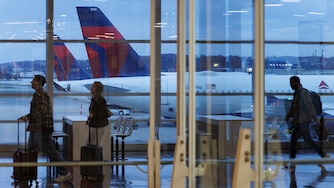
She scoured BWI with three suitcases and a carry-on bag, searching for a place to sit. Many seats were occupied by anxious travelers who’d been there for hours. Fierros, and others, resorted to the window frame. At least it’s a place to sit.
“More than anything, I’m just tired,” she said.
Fierros typically stays awake on flights. She’s gotten through her latest reading “Onyx Storm,” a novel by Rebecca Yarros.
On her next flight, though, which is delayed out of BWI, she’ll be asleep, she said.
Millions of travelers impacted
A family member told Lina Syleest to fly out of BWI on Friday. It’s closer to their home, where the 26-year-old has been since Wednesday, than other airports in the region.
Shock and confusion overtook her — and not just because she was in a new airport. All of the Southwest kiosks were blocked with people. An airport staff member informed her of the ground stop.
“That’s scary,” she said. But by roughly 6:40 p.m., when she was set to be in the sky headed for her hometown of Fort Lauderdale, Florida, she was stuck looking at the wall of flight delays and cancellations. Hers was among them.
Southwest staffers at BWI said they were unable to reschedule her flight, so she called customer service. There’s a two-hour wait, but she’ll manage.
“They do need to get it in control because I don’t want to be in the sky and it happens again,” she said.
According to FlightAware.com, a website tracking air travel, there are more than 1,600 flights delayed and over 1,400 cancelled nationwide.
Jennifer Angarita, 38, was in the air from Denver when a flight attendant alerted her and other travelers of the stoppage.
The flight attendant assured travelers they were unaffected because they were already in flight but couldn’t say the same for those on connecting flights, Angarita said.
“When everyone landed, people clapped,” she said.
While others had to figure out their connecting flights, Angarita was relieved to be home, or at least closer to her home in Rockville. What outraged her were the Uber prices that were upward of $160, she said. Luckily, she found an $80 Lyft.
“I just wanted to get home to my babies,” said Angarita, a mom of two young kids.
At least 600 flights were diverted as a result of the FAA’s order. About 496 flights were diverted to the airport from which they took off, while 104 were sent to a different airport, according to Cirium, an aviation analytics company.
Among the airports where many of the flights were diverted were Chicago O’Hare, Denver International, Dallas Fort Worth International and Reagan National.
Some 11,000 flights carrying more than 1.5 million passengers were scheduled to take off from airports in the U.S. after 4 p.m., raising the likelihood of more cancellations and flight diversions.
JetBlue said only Europe-bound flights out of Boston Logan International and New York’s John F. Kennedy International would be able to depart Friday night.
“We expect disruptions to continue into tomorrow, including additional cancellations,” JetBlue said in a news release.
Trains did not prove a more stable alternative to flying on Friday evening. Error messages popped up on Amtrak’s online platforms for some of those attempting to book, cancel or change their trips during the ground stop. It’s not clear when the issue began or how widespread it was, but many began to complain on the train service’s social media platforms.
W. Kyle Anderson, director of communications for Amtrak, said in an emailed statement that “Amtrak service is operating normally, and we are seeing increased demand for travel across our network.”
Outdated technology may have contributed to flight stoppage
The problem appeared similar to a regional air traffic control communication outage in September that snarled hundreds of flights across the Northeast, aviation safety expert Steve Arroyo said. It may be linked to the outdated technology used by air traffic controllers.
“If you don’t have that ability, whether it’s because the old wires that they have are just run-down or, for whatever reason, you’ve got to stop airplanes on the ground,” said Arroyo, a former United Airlines pilot, “and not put them in the air, where you’re going to risk not being able to communicate with them.”
This is the first time the agency has issued a nationwide ground stop since January 2023, which was triggered by a computer system malfunction.
The nationwide stoppage comes a month after the FAA introduced Strategic Management of Airspace, Routes and Trajectories, an AI tool that compiled data to give air traffic controllers a sense of flight diversions, runway congestion and shifting weather, in some airports. The new tool was available at BWI, Dulles International and Reagan National.
Markwayne Mullin, the secretary of homeland security, said “that everyone is safe, and there’s no reason to be concerned. It’s a telecommunications outage, and there’s no indication it was a nefarious act.”
“As many cyberattacks that take place, you make that assumption. But, as of right now, that’s not known,” he said. “The first thing we want to do is make sure we restore the communications, we get all the flights on the ground, and then we get back to normal operations.”
Mullin said there’s no indication the problems are linked to the new computer system.
Banner reporter Sara Ruberg and the Associated Press contributed to this article.
This article has been updated.



Comments
Welcome to The Banner's subscriber-only commenting community. Please review our community guidelines.